
Mexico City has a rich history, and it’s nearly impossible to miss when you visit. 30 miles outside of the city sits the archaeological site of Teotihuacan. When you enter you are immediately struck by the Temple of the Sun, the largest structure here. Pictures don’t even do the scale justice, but it is massive. The large central street, Street of the Dead, was the main road, spanning the 2+ miles of this city, allows you access to this Temple, and all the other structures in the city, including the Temple of the Moon at one end of the Street (seen behind me in the photo above). The city was built and settled as early as 400BC, and was the most powerful city in the region in 400AD. When the Aztecs found it, and named it, 1000 years later, the city had already been abandoned for centuries. No one really knows its origins or history, other than the remains and murals that can be found here.


There are a couple remaining structures in the city that you can go inside of. One is the Quetzalpapaloti Palace, which was potentially the residence of Teotihuacan. The name means “beautiful butterfly” and is called that because of the carved columns in the central courtyard. Inside the temple of the private residence are murals, deteriorating, but still vibrant and legible after all of this time. It’s incredible to walk around Teotihuacan and see so much of it still standing after all of these years!


The rock design of this city is so beautiful and intricate. Big rocks bordered by tiny ones creating this design, and looking almost like a painting. I’m kind of in love with this pattern – I want a piece of art or pottery that utilizes this design!


Back in the city, at the National Palace, Diego Rivera’s murals also tell the story of Mexico. Located in the Zocalo, the central plaza in Mexico City, this is where the king of the Aztecs, Moctezuma, ruled before the arrival of the Spanish. Filling the halls of the 2nd floor of the huge Palace, each piece is dedicated to something important to this place. From paying homage to the agriculture that Mexico was built upon, to telling the literal history of the city, these murals are massive, with so much depth of field allowing for full stories to be told with rich detail in each piece.


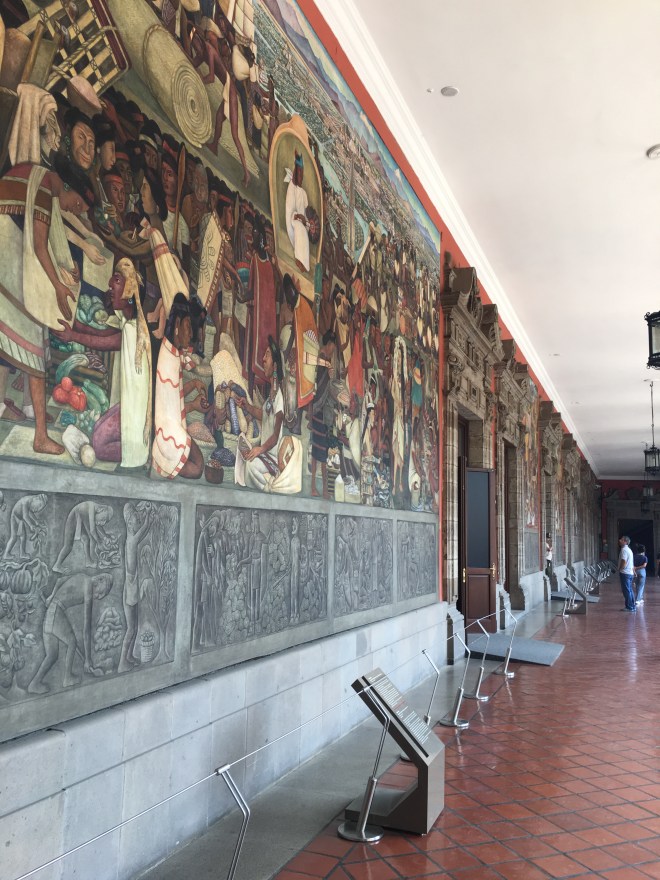
The Amate Fig Tree and maguey (1951), Cocoa (1950), and Maize (1950) each tell the story of the importance of these agricultural products in Mexican culture. Maguey (agave) and nepal were used for constructing houses. Pulque (fermented agave) was made into a drink for nobles and warriors, and still has a large presence in the city today. Similarly, Cocoa plays a big role in Mexico – cocoa beans used as currency amongst the Aztecs, and used in different drinks past and present, of which Hot Cocoa is still very big today. And lastly, corn is the lifeblood of this place. It was the main food of Mesoamerica, and still remains a part of every meal I had while in town. It is the symbol of nourishment for this country.


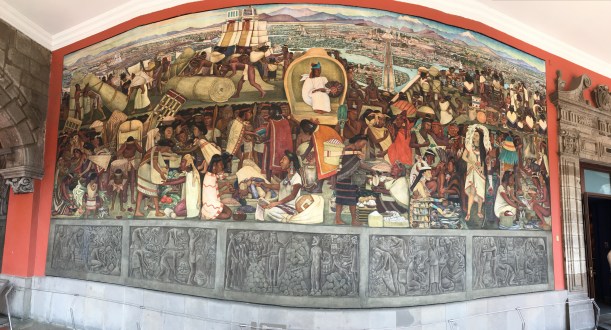
The other murals in the hall are about the history and culture of Mexico. From telling the story of Tenochtitlan, depicting the market there and the bartering that took place between the Aztecs, to glorifying the architecture and agriculture that the world owes a lot to Mexico for. I especially love The Great Tenochtitlan (1945) seen directly below, with it’s bright turquoise on the Aztecs, and Rivera’s stylized depiction of the pyramids of the city.



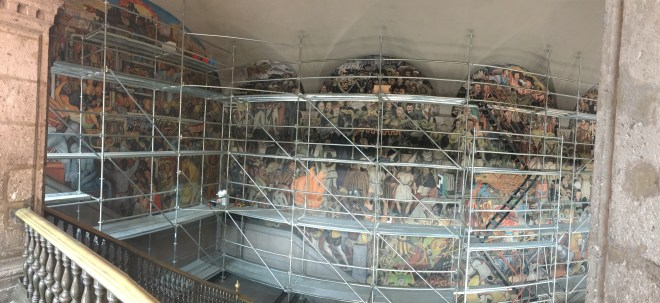
Unfortunately the epic The History of Mexico mural was being restored, so scaffolding covered the entire thing. It’s worth posting the photos though, just to see how massive it is! It was painted between 1929 and 1935, depicting the history of Mexico, past and present. The mural can be seen as a declaration that the revolution brought justice to the Mexican people. Rivera emphasizes the rich cultural heritage of Indians and the Mexican civilization before the conquest. Packed with different scenes and important figures of Mexican history, past, present, and even future.

The history of indigenous civilizations before the Spanish conquest still plays such a large role in Mexico today. The influence from these different civilizations is seen in the colors, the traditional art and design, and in so many artifacts that us tourists visit in hopes of finding today.
 The Laid-Off Life
Amazing, Jeni!!
LikeLike